
15 May What Is a Slab Fracture in Dogs and Why Is It So Common in Chewers?
As a board-certified veterinary dentist, one of the most common—and most preventable—dental injuries I diagnose in dogs is the slab fracture, particularly of the maxillary (upper) 4th premolar. Despite how frequently these fractures occur, many pet owners have never heard the term until their dog is suddenly in pain or requires advanced dental care. Understanding what a slab fracture in dogs is, why it happens so often in certain dogs, and how we treat it can help you better protect your pet’s oral health.
What Exactly Is a Slab Fracture?
A slab fracture is a very specific type of tooth fracture that most commonly affects the upper fourth premolar teeth in dogs—often referred to as the “carnassial teeth.” (The lower carnassial tooth is the mandibular 1st molar.) These are large, blade-like teeth located on the sides of the upper jaw and are designed for shearing and crushing food.
In a slab fracture, a vertical portion of the tooth breaks away, typically along the outside (buccal/cheek) surface. Imagine a thin “slab” of the tooth splitting off—hence the name. Unlike a simple chip, slab fractures often expose the inner pulp of the tooth, which contains nerves and blood vessels. This exposure can be extremely painful and creates a direct pathway for bacteria to enter the tooth, leading to infection and abscess formation around the apex (tip) of the root deep in the bone.
Why Are Slab Fractures So Common?
Slab fractures are not random; they are strongly associated with chewing behavior and the types of objects dogs are given or allowed to chew.
1. Chewing on Hard Objects
The number one cause of slab fractures is chewing on objects that are simply too hard. Common culprits include:
- Natural bones (cooked or raw), especially large marrow bones
- Antlers
- Hooves
- Pig ears
- Hard nylon toys
- Ice cubes
- Rocks
- Large sticks
These objects do not “give” under pressure. When a dog applies strong biting force, especially with the carnassial teeth, the tooth can crack instead of the object breaking.
A good rule of thumb that I go by is:
- Can you bend or break it?
- Could pound a nail with it?
- Would you want it thrown at your knee?
If you can’t answer “yes” to ALL of those questions, the object is too hard for your dog’s teeth.
2. Anatomy of the Carnassial Tooth
The upper fourth premolar is uniquely shaped and bears significant force during chewing. Its large size and position make it the primary tooth used for crushing hard materials. It is a three-root tooth with its roots seated deeply in the surrounding bone. Unfortunately, its structure also predisposes it to slab fractures when excessive force is applied.
3. Breed and Chewing Tendencies
Some dogs are simply more enthusiastic chewers than others. Breeds commonly seen with slab fractures include:
- Labrador Retrievers
- Golden Retrievers
- German Shepherds
- Pit Bull-type dogs
These breeds often have strong jaws and a natural inclination to chew. Combine that with access to hard chew items, and the risk of fracture increases significantly. However, it should be noted that many more breeds should be on this list and any dog can have a slab fracture from chewing on inappropriate items.
4. Age and Wear
Over time, repeated chewing on hard objects can create micro-damage within the tooth. Eventually, this cumulative stress can result in a sudden fracture—even if the dog has been chewing similar items for years without issue. Sometimes the tooth doesn’t fracture, but it can be worn down by chronic chewing.
Signs Your Dog May Have a Slab Fracture
One of the challenges with slab fractures is that dogs are incredibly stoic. They often continue eating and behaving normally, even when experiencing significant dental pain.
However, there are subtle signs you can watch for:
- Chewing on one side of the mouth
- Dropping food while eating
- Reluctance to chew hard treats or toys
- Pawing at the face
- Bad breath (due to infection)
- Visible missing portion of a tooth
- Brown or pink discoloration in the center of the tooth (indicating pulp exposure)
In some cases, the fracture is discovered incidentally during a routine veterinary exam. Quite often, the fractured tooth will have calculus asymmetry. This is observed when a dog will literally shift food to the other side for chewing and away from the painful tooth. The painful fractured tooth will not receive the benefit of chewing and saliva flow. This will accelerate the speed of calculus formation on that tooth compared to its counterpart on the other side of the mouth.
Why Prompt Treatment Matters
A slab fracture is not just a cosmetic issue—it is a medical problem that requires timely attention.
When the pulp is exposed, bacteria quickly invade the inner structures of the tooth. This will lead to:
- Pulpitis (inflammation of the pulp)
- Tooth root infection
- Abscess formation
- Bone loss around the tooth
- Chronic pain
Left untreated, the infection can spread beyond the tooth, affecting surrounding tissues and potentially entering the bloodstream.
Sometimes the fracture does not penetrate to the pulp, but the tooth can still become infected and abscess since dentin, which surrounds the pulp, is initially permeable after being exposed. If the dentin and pulp do not protect themselves in time, the pulp will become infected.
How is a Slab Fracture in Dogs Treated?
Treatment depends on several factors, including the extent of the fracture, whether the pulp is exposed, and the overall health of the tooth.
1. Root Canal Therapy
For many dogs, root canal therapy is the preferred treatment, especially for strategic teeth like the carnassial tooth. Root canal therapy is always combined with dental imaging in the form of either cone beam CT scans or digital dental radiographs.
During this procedure:
- The infected pulp is removed
- The inner chamber of the tooth is cleaned and disinfected
- The space is filled with a special material
- The pulp chamber is closed and sealed with composite restorations as the final step of a root canal procedure.
- A fractured tooth that is treated with root canal therapy is often prepared for a metal crown. Impressions are then taken and sent to an outside laboratory for metal crown fabrication. Our practice utilizes a laboratory, Creature Crowns, that has become the leader in metal crown fabrication in veterinary dentistry. The crown is then cemented in place about 2-3 weeks later during a brief anesthetic procedure.
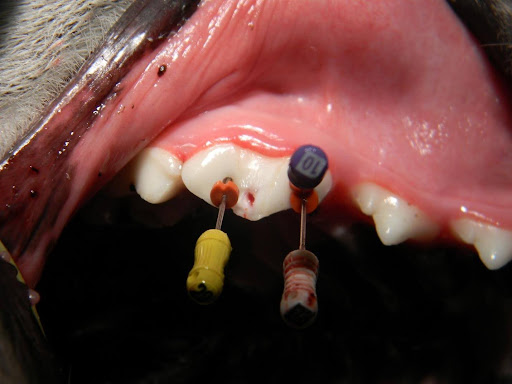
Intra-op root canal therapy on an upper 4th premolar with a slab fracture and pulp exposure.
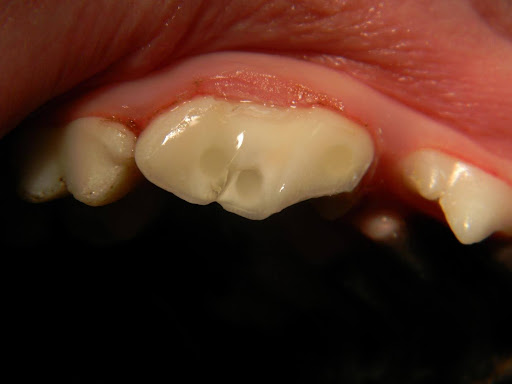
Finished root canal procedure on an upper 4th premolar.
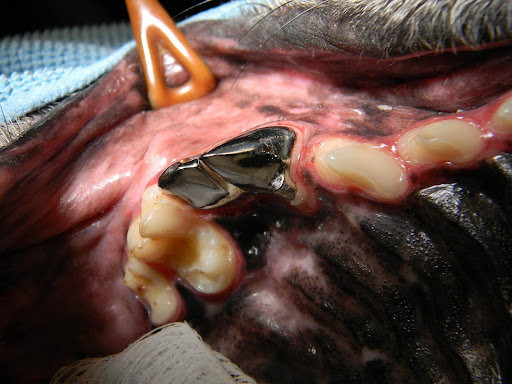
A metal (talladium) crown that has been cemented in place on an upper 4th premolar after it was treated with root canal therapy.
The advantage of root canal therapy is that it preserves the tooth. This is particularly important for large chewing teeth that play a key role in normal function.
Dogs recover quickly from this procedure and can return to normal activity soon after, though we still recommend avoiding hard chew items moving forward.
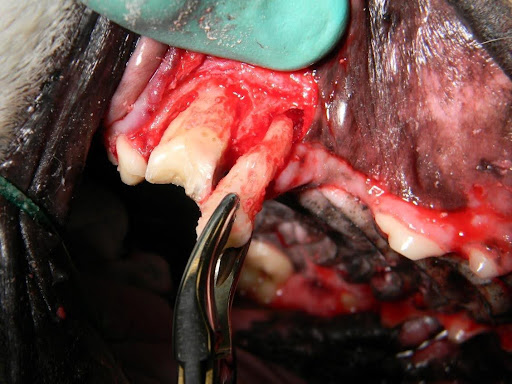
2. Tooth Extraction
In some cases, extraction is the better option. This may be recommended if:
- The fracture is extensive
- There is severe infection or bone loss
- The tooth is not structurally salvageable
- Financial considerations limit other options
Extracting a carnassial tooth is more complex than removing a smaller tooth due to its size and multiple roots. It requires surgical expertise and careful post-operative care.
While dogs do adapt well after extraction, preserving the tooth when possible is generally ideal. When indicated, root canal therapy is always preferred. The dog gets to keep the tooth and does not have to go through extraction recovery.
3. Vital Pulp Therapy (in Select Cases)
If the fracture is very recent and the pulp exposure is minimal, a procedure called vital pulp therapy may be an option. This is more commonly performed in younger dogs.
The goal is to preserve the vitality of the tooth by protecting the pulp before infection sets in. However, timing is critical, and not all cases qualify. It has to be documented that the fracture took place no more than 24-72 hours prior to presentation. If there is no definitive history about when the fracture took place, the tooth will not be a candidate for vital pulp therapy.
Prevention: The Best Treatment of All
The good news is that slab fractures are largely preventable.
Choose Safe Chew Options
Opt for chew items that have some flexibility or “give,” such as:
- Veterinary-approved dental chews
- Rubber toys designed for dogs
- Products that can be indented with your fingernail
Avoid anything excessively hard, even if it is marketed for dogs.
Supervise Chewing
Pay attention to how your dog interacts with chew items. If they are aggressively biting down on hard objects, it’s time to intervene. Those types of toys need to always be avoided.
Regular Dental Checkups
Routine veterinary dental exams allow us to catch problems early—sometimes before you notice any signs at home.
Professional dental cleanings and dental X-rays are also essential, as many issues occur below the gumline and are not visible externally.
Educate Everyone in the Household
Well-meaning family members may offer inappropriate chew items without realizing the risk. Make sure everyone understands what is safe—and what is not.
A Final Word to Pet Owners
Slab fractures are one of the most common dental injuries I see in practice, and they are almost always linked to chewing habits. While dogs have a natural instinct to chew, it is our responsibility as pet owners to guide that behavior safely.
If you ever notice a broken tooth—or even suspect something isn’t right—don’t wait. Early intervention can mean the difference between saving a tooth and losing it, and more importantly, it can spare your dog from unnecessary pain.
Your dog may not be able to tell you when their mouth hurts, but with awareness and proactive care, you can make a meaningful difference in their comfort and long-term health.
If you are concerned that your dog has a tooth fracture, please call Animal Dental Care and Oral Surgery in Colorado Springs. One of our board-certified veterinary dentists can evaluate your dog and give you the best treatment options.