

08 May Dental Disease and Organ Damage in Pets: Why Oral Health Matters More Than You Think
When most pet owners think about dental disease, they picture bad breath, yellow teeth, or perhaps the need for a dental cleaning. While these are certainly visible signs, they are only the tip of the iceberg of a much more serious issue. As a board-certified veterinary dentist, I want to emphasize an often-overlooked reality: the strong and clinically significant connection between dental disease and organ damage in pets.
This is not simply a matter of oral hygiene. It is a whole-body health concern. What goes on in the mouths of our pets does not stay in the oral cavity but has numerous negative and widespread implications. The mouth is a gateway to the bloodstream, and when disease takes hold there, it can have ripple effects throughout the body, impacting vital organs like the heart, kidneys, and liver. The worse the disease within the mouth is, the worse the negative changes in other organ systems.
Understanding this connection can change how we approach our pets’ dental care and ultimately help them live longer, healthier lives.
What Is Dental Disease in Pets?
Dental disease, specifically periodontal disease, is one of the most common conditions we diagnose in dogs and cats. In fact, by the age of three, most pets have some degree of periodontal disease.
It begins with plaque, a sticky film composed of bacteria, saliva, and food debris that accumulates on the teeth. If not removed, plaque mineralizes into tartar, creating an ideal environment for harmful bacteria to continue to grow and enter the bloodstream in even greater numbers.
These bacteria trigger inflammation of the gums (gingivitis), which can progress to periodontal disease. Gingivitis alone is the first stage of periodontal disease. At this stage, infection extends below the gumline, damaging the ligaments and bone that support the teeth.
But the most important takeaway is that dental disease is not confined to the mouth.
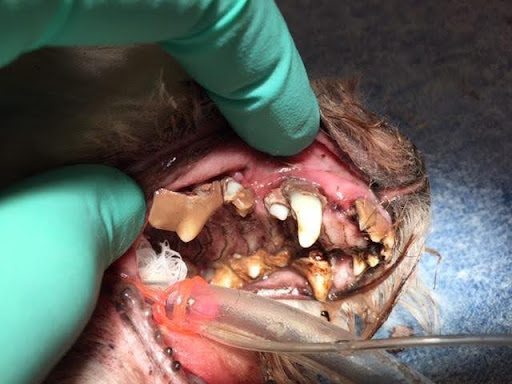
End-stage periodontal disease in a patient who has gone untreated for years. This surely has led to extensive spread of bacteria into the bloodstream and tissues of the body.
The Missing Link: How Oral Bacteria Enter the Bloodstream
Healthy gums act as a barrier, keeping bacteria safely contained within the oral cavity. Small amounts of bacteria normally enter the bloodstream and are quickly cleared. However, when periodontal disease develops, that barrier becomes compromised.
Inflamed and infected gums allow bacteria to enter the bloodstream, a process known as bacteremia. This doesn’t just happen during dental procedures; it can occur during everyday activities like chewing, eating, or even grooming.
It should be stressed that bacteria that enter the bloodstream during a dental procedure are at a similar safe level as daily activities, such as eating a meal. However, bacteria that enter the bloodstream daily from periodontal disease is at a much greater level.
Once these bacteria gain access to circulation, they can travel throughout the body. This is where the connection between dental disease and organ damage in pets becomes critically important.
An underappreciated aspect of periodontal disease is that the destruction of periodontal tissues and the propagation of dental disease is not due to a weak immune system. Rather, it is due to an overactive and robust immune system response. The immune system does not know what to do in the face of untreated infection. This results in the breakdown of periodontal tissue to rid the body of its own teeth. The body is literally turning on itself in an effort to rid itself of the infection source, the teeth.
The Heart: A Primary Target
One of the most serious consequences of untreated dental disease is its potential impact on the heart.
As bacteria circulate, they can attach to the heart valves, particularly in pets with pre-existing valve abnormalities or age-related changes. This can lead to a condition called endocarditis, an infection of the valves of the heart. This is most often due to aerobic bacteria that require oxygen to grow and multiply.
Over time, this infection can:
- Damage heart valves
- Severe fever events
- Disrupt normal blood flow
- Lead to heart failure in severe cases
Even without full-blown infection, chronic inflammation caused by dental disease can put added strain on the cardiovascular system. This makes the relationship between dental disease and organ damage in pets especially relevant for senior animals and breeds prone to heart disease.
The Kidneys: Silent Victims of Chronic Infection
The kidneys are another organ system highly vulnerable to circulating oral bacteria.
Because the kidneys filter blood continuously, they are exposed to any bacteria that enter the bloodstream. These bacteria, and the immune response they trigger, can damage the delicate filtering structures within the kidneys.
Over time, this can contribute to:
- Reduced kidney function
- Chronic inflammation
- Progressive kidney disease
What makes this particularly concerning is that kidney disease often develops gradually and silently. By the time clinical signs appear, such as increased thirst, weight loss, or decreased appetite, significant damage may already have occurred.
This is a clear example of how dental disease and organ damage in pets can be connected in ways that are not immediately visible to pet owners.
The Liver: The Body’s Overworked Filter
The liver plays a central role in detoxifying the bloodstream, metabolizing nutrients, and supporting immune function. The liver also plays a significant role in the production and metabolism of different proteins. When oral bacteria repeatedly enter circulation, the liver must work harder to filter and neutralize them.
Chronic exposure to bacteria and inflammatory byproducts can lead to:
- Liver inflammation
- Reduced metabolism of different proteins
- Impaired detoxification of the blood
While the liver is remarkably resilient, ongoing stress from untreated dental disease can eventually take its toll and lead to permanent damage, such as fibrosis (scarring) of liver tissue.
Again, this reinforces the broader concept that dental disease and organ damage in pets are closely intertwined.
The Role of Chronic Inflammation
It’s important to understand that bacteria alone are not the only culprits. The body’s immune response plays a major role in the damage we see.
When bacteria circulate, the immune system activates to fight them. While this response is essential, chronic activation leads to systemic inflammation.
This persistent inflammatory state can:
- Damage tissues in multiple organs
- Worsen existing health conditions
- Accelerate aging-related changes
In many ways, dental disease acts as a continuous source of inflammatory stress, one that affects the entire body over time.
Why Pets Don’t Show Obvious Signs
One of the challenges in addressing this issue is that pets are incredibly skilled at hiding pain and illness.
A dog or cat with significant dental disease may still:
- Eat normally
- Play regularly
- Show no outward signs of distress
Meanwhile, beneath the surface, infection is progressing, bacteria are entering the bloodstream, and organs are being exposed to ongoing stress.
We must remember that pets will often not display outward signs of pain due to dental disease. It goes against their “fight or flight” mechanisms to show pain. To show pain is to show weakness and be more susceptible as prey, even when a dog has no natural predators in its environment.
This disconnect is why the link between dental disease and organ damage in pets often goes unnoticed until the disease is advanced.
Prevention: The Most Powerful Tool We Have
The good news is that this is one of the most preventable health issues in veterinary medicine.
By managing dental disease effectively, we can significantly reduce the risk of systemic complications.
Professional Dental Care
Routine dental cleanings under anesthesia allow for thorough removal of plaque and tartar, both above and below the gumline. Dental radiographs help detect disease that is not visible on the surface. Animal Dental Care and Oral Surgery in Colorado Springs utilizes cone beam CT imaging on the majority of our cases. This 3-dimensional means of imaging has largely replaced full mouth dental radiographs in our practice since CBCT gives us far more information and decreases anesthesia time when compared to dental radiographs.
Home Dental Care
Daily tooth brushing is the gold standard for preventing plaque accumulation. Brushing every other day on average is not nearly as effective as daily brushing, but will still decrease plaque accumulation on teeth.
Dental Diets and Chews
Veterinary-approved dental products can help reduce plaque and support oral health when used consistently. While they will not be a substitute for daily tooth brushing, if they decrease overall plaque bacteria numbers, they will be impactful.
Early Intervention
Addressing dental issues early prevents progression to advanced disease and minimizes the risk of bacteria entering the bloodstream.
A Whole-Body Approach to Pet Health
As veterinary dentistry has evolved, so has our understanding of how interconnected the body truly is. The mouth is not an isolated system; it is part of a larger, dynamic network.
When we talk about dental disease and organ damage in pets, we are really talking about the importance of viewing oral health as a critical component of overall wellness.
Protecting your pet’s teeth and gums is not just about preventing extractions or improving breath. It is about:
- Supporting heart health
- Preserving kidney function
- Reducing strain on the liver
- Minimizing chronic inflammation
Final Thoughts
Dental disease is the most common and most underestimated health conditions affecting pets today. Its impact extends far beyond the mouth, with the potential to influence major organ systems in meaningful ways.
The connection between dental disease and organ damage in pets is well established, and it underscores the importance of proactive, preventive care. This will have the greatest impact on your pet, having a pain-free and infection-free oral cavity.
If your pet has not had a recent dental evaluation, now is the time to start the conversation with your veterinarian. Early detection and routine care can make a profound difference; not just in your pet’s oral health, but in their overall quality and length of life.
A healthy mouth truly supports a healthy body, and in veterinary dentistry, that connection is something we see every single day.
If you are concerned about your pet’s oral health, please feel free to make an appointment with one of our board-certified veterinary dentists at Animal Dental Care and Oral Surgery in Colorado Springs.
Photo by Glomad Marketing on Unsplash used with permission under the Creative Commons license for commercial use 05/08/2026